
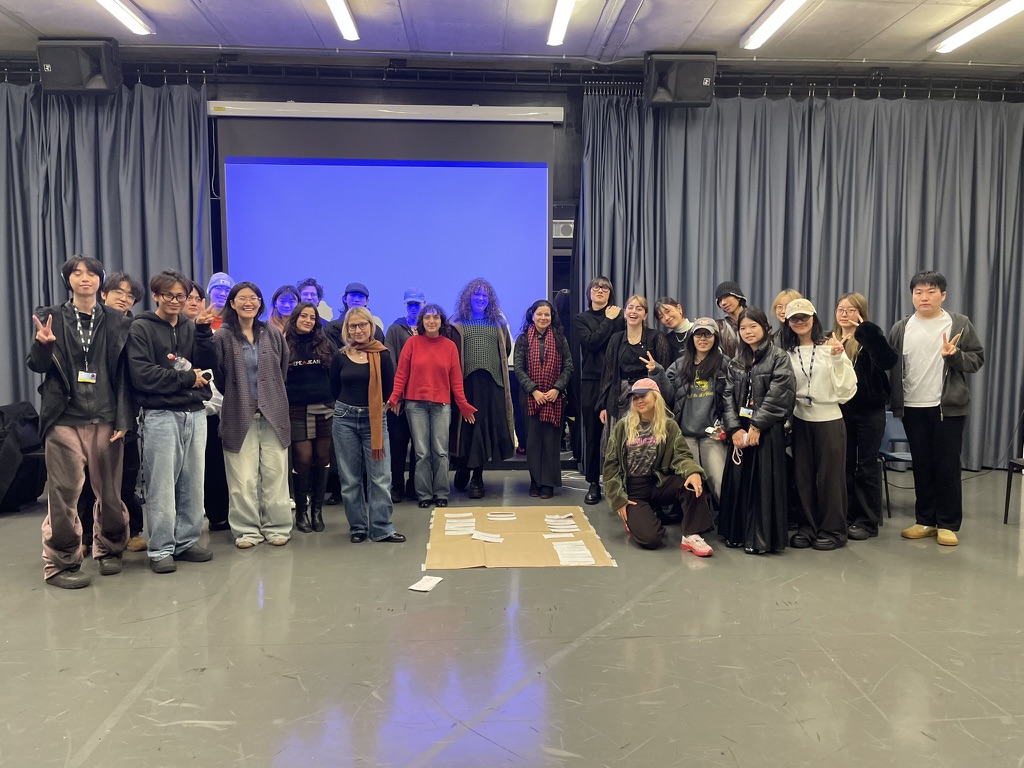
(Lowry, C. 2025)
I gathered research data at key points during the students’ collaborative project with London Contemporary Dance School (LCDS). This began with an interview with course leader Gabi Tropia, which helped identify the key issues to be explored through the research (addressing unconscious bias, discriminatory language, fosteing ethical collaboration and encouraging reflection on positionality). Data was then collected during the Manifesto Making Workshop, prior to the LCDS collaboration, using a combination of Likert-scale questionnaires, written reflections, and arts-based research through collective manifesto creation. The final data point was gathered three weeks later, immediately after the screening of the students’ short films, through a reflective workshop with CSM students that used focus groups and collective editing of the manifesto to evaluate the impact of the manifesto on collaborative practice.
In this blog, I explore the themes that emerged from the manifesto itself, the questionnaire responses, and the post-project reflective workshop.
The Manifesto:
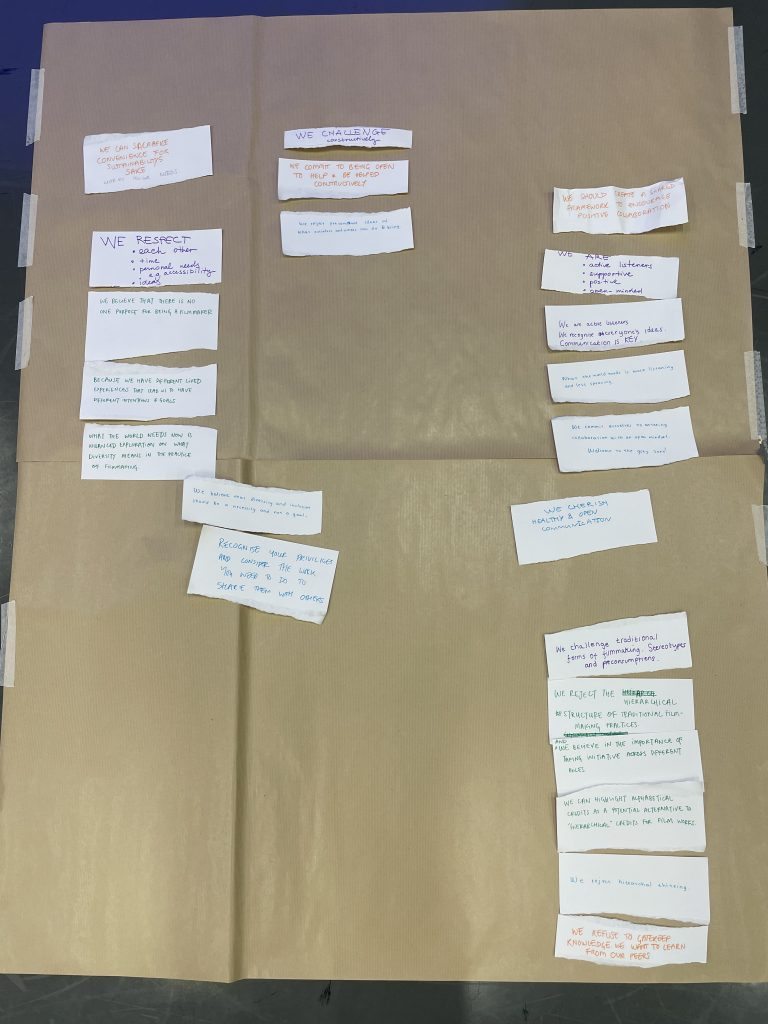
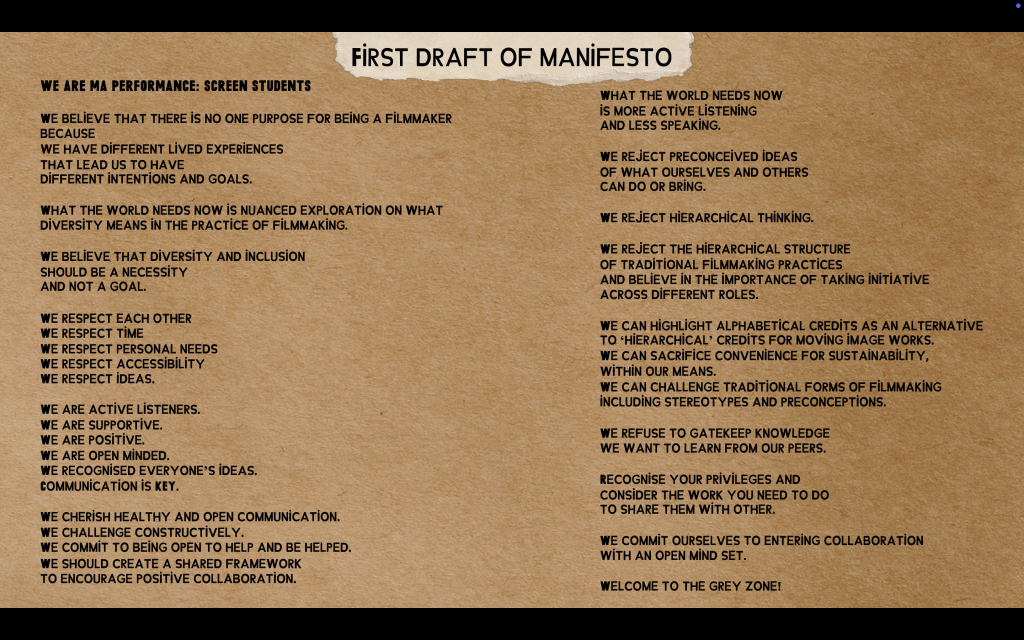
Below is a photograph of the original layout of the manifesto, created by the students collectively during the first workshop. After the workshop I typed this up and sent it to the students as a live working document so that they could utilise it during the project.
analysis and interpretation of the Manifesto
Looking at the manifesto alongside the wider data set, I understood that as an arts-based research tool, it was an early articulation of values held by the students that were later tested, complicated, and deepened through practice. The manifesto’s emphasis on listening, respect, shared responsibility, and rejection of hierarchy aligns closely with themes that emerged in the questionnaires and participatory workshops, where students described ethics in relational terms and valued collective approaches to decision making.
However, some elements that later emerged as important themes for the students were absent from the original manifesto. For example there was no explicit attention to time pressure, conflict, emotional labour, and compromise, all themes that became central to the debrief conversation following the LCDS collaborative project. This contrast highlights a shift from aspirational ethical positioning to practice-based ethical understanding.
Where the manifesto framed ethics as intention and attitude, the later data revealed ethics as something negotiated under constraint, requiring repair, care, and conscious communication. Analysed together, the data suggests that the manifesto functioned as a necessary starting point, providing shared language and values, while the subsequent collaboration and reflective workshops enabled students to encounter the limits of those values and revise them through lived experience. This progression demonstrates how ethical understanding developed through an action research cycle of articulation, application, reflection, and revision. It also speaks to a theme that emerged in the first questionnaire’s, a concern that the manifesto could just be a semantic tool for blue sky thinking. This was something that I had sought to avoid, as per Helguera’s (2011) notion of socially engaged arts requiring ‘actual’ action.
The manifesto in itself served many purposes, and alongside the initial questionnaire data (outlined below), I was able to draw out specific themes to further investigate in the evaluation workshop.
Analysis and Interpretation of the Questionnaire and First Workshop
The questionnaire combined Likert-scale responses (1–5) with open-ended reflective comments. Below I go through each question and interpret the data through the following methods:
- Likert-scale data was treated as ordinal data and analysed using descriptive statistics (mean, range, and distribution of agreement).
- The students written responses were analysed using thematic analysis, identifying recurring patterns in how participants described learning, confidence, and practice.
This mixed-methods approach allowed me to measure both the impact and reflections on the student’s experience of the workshop. I initially shared some of the research with my peers during the ARP workshop, and they were very helpful in supporting me to make connections and groupings, whilst also bearing in mind the potential for participants to select positive options on the form to ‘please’ me as the researcher/their tutor. Looking for themes with other researchers helped to navigate the ‘mess’ (Cook, T. 2009) and mitigate the investigator bias that I might have, especially as I have an existing relationship to the students. Together with my peers, I found that the written responses offered possibly a more nuanced response to the research questions than the Likert scale alone.
Question 1
“The workshop helped me reflect on my own positionality as a filmmaker.”
| Likert response | Number of participants | Percentage |
| 1 – Strongly disagree | 0 | 0% |
| 2 – Disagree | 0 | 0% |
| 3 – Neutral | 2 | 8.3% |
| 4 – Agree | 12 | 50.0% |
| 5 – Strongly agree | 10 | 41.7% |
Selected Participants Quotes:
I realised I am privileged because I feel comfortable speaking in a group. I had to listen more while discussing.
To be honest I felt a bit exposed thinking about my positionality. I appreciate you acknowledged that it can be hard and heavy to think about this.
Helped me recognise not only my vulnerabilities but also the forms of privilege I carry especially the power I hold as a storyteller to frame others experiences.
Discussing this with others was reassuring.
The workshop helped me to acknowledge that my privileges have shifted when I moved to the UK and I felt sad but also relived to acknowledge that.
Now I see I need to be more conscious of diverse lived experiences.
To be honest I felt a bit exposed thinking about my positionality. I appreciate you acknowledged that it can be hard and heavy to think about this.
Interpretation:
Over 91% of participants agreed or strongly agreed that the workshop supported reflection on positionality, suggesting the intervention was effective in prompting critical self-awareness around identity, perspective, and privilege. The feedback comments also revealed that this reflective process also brought up challenging feelings and emotions, including ‘sadness’ and feeling ‘exposed’. Some students noted that they appreciated the acknowledgement I made of the challenges this work brings up, however it makes me wonder about how to make the session supportive longer term.
Question 2
“I have developed a clearer understanding of what ethical and inclusive filmmaking means in practice.”
| Likert response | Number of participants | Percentage |
| 1 – Strongly disagree | 0 | 0% |
| 2 – Disagree | 0 | 0% |
| 3 – Neutral | 3 | 12.5% |
| 4 – Agree | 14 | 58.3% |
| 5 – Strongly agree | 7 | 29.2% |
Selected Participant Key Words:
Caring
Respect
Equality
Care
Non-hierarchical
Listening
Communicative
Interpretation:
Nearly 88% of participants reported increased clarity, indicating the workshop was successful in translating ethics from abstract concepts into practical understanding. The definitions that students wrote generated some key words that appeared throughout the process which helped to organise themes.
Question 3
“The process of co-creating a manifesto helped me think differently about shared responsibility and ethics in filmmaking.”
| Likert response | Number of participants | Percentage |
| 1 – Strongly disagree | 0 | 0% |
| 2 – Disagree | 0 | 0% |
| 3 – Neutral | 4 | 16.7% |
| 4 – Agree | 11 | 45.8% |
| 5 – Strongly agree | 9 | 37.5% |
Selected Participant Quotes:
The collective aspect was crucial as discussions like this necessitate varied perspectives.
The collective lens transformed my focus from ‘what do I want to say’ to ‘what can we discover together’.
Helped me solidify or mould my own approach which can be quite rigid.
They brought up things I was not even considering. However, I do feel that because the discussion was done in a big group, there was not enough depth or nuance and the statements felt somewhat superficial.
It made me consider things I hadn’t even thought of.
At the same time, it was difficult to discuss the principles with someone who holds more power than you.
Interpretation:
Over 83% of participants agreed or strongly agreed, suggesting that collective manifesto-making was effective in shifting thinking towards shared ethical responsibility rather than individual accountability alone. The comments also compounded this, however they also raised interesting challenges about power dynamics in a diverse cohort, as the last quote articulates. It was also notable that for some students they worried about the group aspect perhaps ‘watering down’ the statements, that try to appease the majority, rather than delving into the specificity required for meaningful intersectional action.
Question 4
“I feel more confident in applying ethical and inclusive principles in future film collaborations.”
| Likert response | Number of participants | Percentage |
| 1 – Strongly disagree | 0 | 0% |
| 2 – Disagree | 0 | 0% |
| 3 – Neutral | 2 | 8.3% |
| 4 – Agree | 12 | 50.0% |
| 5 – Strongly agree | 10 | 41.7% |
Selected Participant Quotes:
I will try to listen more and allow space for others.
I love the idea of manifestos! It’s like a constitution – maybe we’ll create one for the future collaborations.
Listen to each other with respect.
I will maintain patience with some ideas I may disagree with.
I am an open-minded person by nature.
Interpretation:
Over 91% of participants reported increased confidence. The small proportion of neutral responses suggests that while confidence improved overall, some students may benefit from further opportunities to apply principles in live or assessed contexts and other students already felt confident with their approach to ethical and inclusive practice. Again, themes of listening, taking time and being open emerged for many.
Question 5
“This type of manifesto-making workshop is an effective way to promote inclusive and caring filmmaking practices.”
| Likert response | Number of participants | Percentage |
| 1 – Strongly disagree | 0 | 0% |
| 2 – Disagree | 1 | 4.2% |
| 3 – Neutral | 1 | 4.2% |
| 4 – Agree | 9 | 37.5% |
| 5 – Strongly agree | 13 | 54.2% |
Selected Participant Quotes:
I realised I felt closer to other group members, it helped me communicate with others effectively.
Longer sessions! With most conversations, 1 session isn’t enough to really emphasise the importance of digging deeper with regards to these issues.
I’m afraid all of this is just a slogan. Most of us cannot do like it during the process.
I think that talk is often louder than actions and I am unsure if a manifesto is enough to make it happen in practice (sorry to be cynical).
Everything works so well! Love it!
Give more time to discuss practical examples and how we can implement the statements into real life.
Interpretation:
Over 91% of participants viewed the workshop format as effective, with more than half strongly agreeing. This provides strong support for manifesto-making as a pedagogical tool within screen education, which was heartening to see! However, I also saw that many comments showed concern about the possibility of a manifesto being semantical rather than practical. Again, themes of time emerged, needing more time in order to go deeper. I also noted that a student apologised for being critical, again making me conscious of the researcher/lecturer positionality I held, and how this might impact the data collected.
Overall, the Likert-scale data demonstrated consistently high levels of agreement across all five learning outcomes, indicating that the manifesto-making workshop was perceived by participants as effective in supporting ethical reflection, collective responsibility, and confidence in inclusive filmmaking practice. This was a great starting point, but I was curious to discover how this intervention felt after a practical collaborative process. Therefore I met with the students again after their screening event.
Analysis and Interpretation of the Second Workshop, Focus Groups and Collective Group Edit of Manifesto
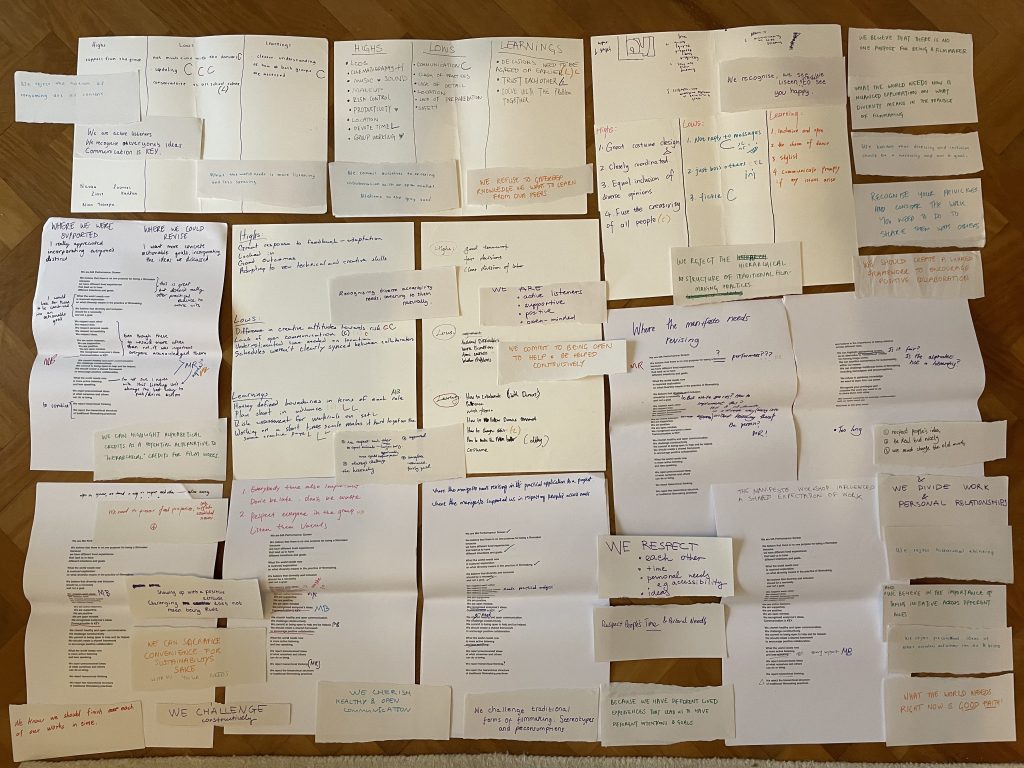
This thematic analysis draws on group reflections gathered immediately following the LCDS dance film collaboration. Working in mixed groups enabled participants to reflect across projects, identifying shared experiences, highlights, challenges, and learning. These were shared through conversations in focus groups, written documentation and a group edit/selection process on the manifesto.
Utilising methodologies laid out by Wolgemuth, J.R., Guyotte, K.W. and Shelton, S.A. (2024) for drawing out thematics from qualitative data, I got physical with the data, moving, cutting and sticking text together and sitting ‘in’ the material. From this, I identified 5 key themes.
Theme 1: The Manifesto functions as a relational scaffold for collaboration
Overview
Across all groups, participants identified strong collaboration happening when roles were clearly defined, communication was open, and decision-making was trusted and efficient.
Indicative patterns in the data included:
- “Good teamwork” and “fast decisions”
- “Clear division of roles”
- “Great response to feedback”
- “Closely coordinated” teams
- Appreciation for mutual respect between CSM and LCDS collaborators
Manifesto connection
Students frequently highlighted manifesto principles relating to respect, communication, and shared values, often annotating these lines as validated by the experience rather than theoretical ideals.
Interpretation
This suggests the manifesto functioned as a relational scaffold, that particularly supported students who had strong communication with their collaborators. Ethical practice was experienced not as an add-on, but as something embedded in everyday working relationships. Importantly, trust emerged as something built through action, not just intention.
Theme 2: Time Pressure Exposed Ethical Tensions and Structural Limitations
Overview
The most consistent low across groups related to time constraints, logistical pressure, and the intensity of a three-week production schedule.
Common issues included:
- Arguments and miscommunication
- Technical difficulties disrupting workflow
- Creative compromises due to time pressure
- Emotional strain and fatigue
Manifesto connection
Several groups questioned whether the manifesto sufficiently accounted for real-world constraints, particularly when time, energy, and institutional expectations came into conflict with care-led intentions.
Interpretation
This revealed an important insight: ethical and inclusive practice is most difficult precisely when pressure is highest. The data suggests that while the manifesto articulated values clearly, students needed more support in understanding how to uphold care and ethics under constraint. This points towards a need to explicitly address compromise, repair, and decision-making under pressure within the manifesto or accompanying teaching. It also speaks to a need for institutional change to implement working practices and project timelines that model ‘best practice’. I fed this back to the Course Leader, who agreed that the time constraints of the project and scheduling issues between LCDS students and CSM students posed substantial issues around care, time and ethical practice. This revealed that it is not enough to just create the manifesto and that the course structure and schedule must also support the environment for the manifesto to be practiced within.
Theme 3: Care, Support and Listening Were Central to the Experience
Overview
Participants frequently identified moments of care, support, and emotional attentiveness as significant learning points, particularly where they felt held during moments of uncertainty or difficulty.
Examples included:
- Feeling supported by peers or tutors
- Appreciation for listening and reassurance
- Recognition of emotional labour within collaboration
- Noticing when care was absent or unevenly distributed
Manifesto connection
Students highlighted manifesto lines related to respect, kindness, and care, often noting that these principles became most visible when something went wrong rather than when things were going smoothly.
Interpretation
Care, support, and listening were experienced as central to ethical collaboration, particularly during moments of uncertainty or difficulty. Students identified feeling listened to and emotionally supported as significant learning points, suggesting that care functioned as an enabling condition for creative practice rather than an optional extra. The manifesto’s emphasis on respect and kindness became most visible when things went wrong, indicating a shift from viewing care as intention to understanding it as an active, practice-based responsibility tested under pressure.
Theme 4: The Manifesto Was Useful but Needs to Be More Actionable and Flexible
Overview
While the manifesto was widely seen as relevant, students also critically identified its limitations after applying it in practice.
Common suggestions included:
- The manifesto being “too long” or difficult to recall in pressured moments
- Needing clearer guidance on what to do when values conflict
- Desire for simpler language or prioritised principles
- Recognition that some principles only became meaningful after the project
Manifesto revision annotations focused on:
- Clarifying accountability
- Addressing conflict and breakdown explicitly
- Making the manifesto easier to use as a live tool rather than a symbolic document
Interpretation
This reflects a mature, practice-based critique rather than rejection. Students did not dismiss the manifesto; instead, they treated it as it was presented – a living document that must evolve in response to real collaboration. This arguably demonstrates the success of the action-research approach: students moved from consuming values to co-authoring and revising them based on experience, demonstrating an active adaptation of their approach in response to their learning.
Theme 5: Praxis is Key to meaningful change
A significant theme was that many insights only emerged after the collaboration had concluded. The reflective workshop enabled students to:
- Reframe challenges as learning
- Articulate ethical tensions retrospectively
- Recognise where intentions and actions diverged
- See the manifesto differently after lived experience
This reinforces the value of structured post-project reflection as a pedagogical tool. The data suggests that the manifesto alone was not sufficient, it was the cycle of action, reflection, and revision that generated the deepest learning. Clearly, a one off workshop is not enough to make meaningful change, however, this cyclical approach offers opportunity for genuine depth of conversation and development within the student cohort, to create an ethical ecology in which students can develop reflexive methodologies.
Summary of findings
The second data set demonstrates that ethical and inclusive filmmaking practices are not fully understood until they are tested under real conditions. The LCDS collaboration surfaced tensions around time, communication, and care, while also validating the manifesto as a meaningful relational scaffold for ethical collaboration. Importantly, the reflective workshop created space for students to critically evaluate both their practice and the manifesto itself, positioning them as reflexive practitioners rather than passive learners. The films that the students created also demonstrated application of the learning, indicating the positive impact caring and ethical practice can have on the outcome as well as the process. This mini action research project also drives home the importance of an iterative and longer term intervention. The two workshops bookending the project provided a useful reflective space where learning could be actioned and the manifesto amended to reflect the groups findings. I will share the current version of the manifesto as part of my presentation.
Bibliography
Ahmed, S. (2012) On Being Included: Racism and Diversity in Institutional Life. Durham, NC: Duke University Press.
Cook, T. (2009) ‘The purpose of mess in action research: building rigour through a messy turn’, Educational Action Research, 17(2), pp. 277–291.
Ellis, C.S. and Bochner, A.P. (2006) ‘Analyzing Analytic Autoethnography: An Autopsy’, Journal of Contemporary Ethnography.
Freire, P. (1992) Pedagogy of Hope: Reliving Pedagogy of the Oppressed. New York: Continuum.
Helguera, P. (2011) Education for Socially Engaged Art: A Materials and Techniques Handbook. New York: Jorge Pinto Books.
hooks, b. (1994) Teaching to Transgress: Education as the Practice of Freedom. New York: Routledge.
Jokela, T. and Huhmarniemi, M. (2015) ‘Art-based action research in the development work of arts and art education’, Art, Design & Communication in Higher Education.
Kemmis, S. and McTaggart, R. (2007) The Action Research Planner: Doing Critical Participatory Action Research. 3rd edn. Dordrecht: Springer.
Lenette, C. (2023) Participatory Action Research: Ethics and Decolonization. Oxford: Oxford University Press.
McNiff, J. (2002) Action Research for Professional Development: Concise Advice for New Action Researchers. 3rd edn. London: RoutledgeFalmer.
McTaggart, R., Nixon, R. and Kemmis, S. (2016) ‘Critical participatory action research’, in The Palgrave International Handbook of Action Research. New York: Palgrave Macmillan, pp. 21–35.
Rosenberg, M. (2015) How to Express Needs | Nonviolent Communication Explained [Video]. YouTube. Available at: https://www.youtube.com/watch?v=3l8l4prc-_Q (Accessed: 12 October 2025).
Willis, J. and Edwards, C. (2014) Action Research: Models, Methods, and Examples. Charlotte, NC: Information Age Publishing.
Wolgemuth, J.R., Guyotte, K.W. and Shelton, S.A. (eds.) (2024) Expanding Approaches to Thematic Analysis: Creative Engagements with Qualitative Data. London: Taylor & Francis.
Leave a Reply