
As the workshop was scheduled as part of the first years curriculum, I ensured that I contacted all of the students both in person and via email two weeks in advance of the workshop to explain the session content, context, and that their participation in the research was completely optional. I provided them with my email address in case they wanted further clarity or discussion. I then created two participant facing documents as part of the research and to agree consent. I sent the forms to Gabi Tropia, Mallika Kanyal and Kwame Baah for feedback ahead of the first workshop session. They were all in agreement that the forms were clear and appropriate for the project. Below is a copy of the first questionnaire:
Here is the second questionnaire that was completed by participants at the end of the second workshop:
All of the participants completed the forms and I typed up the findings into a spreadsheet that anonymised all of the data but enabled me to create themes (which are articulated in the next blog post).
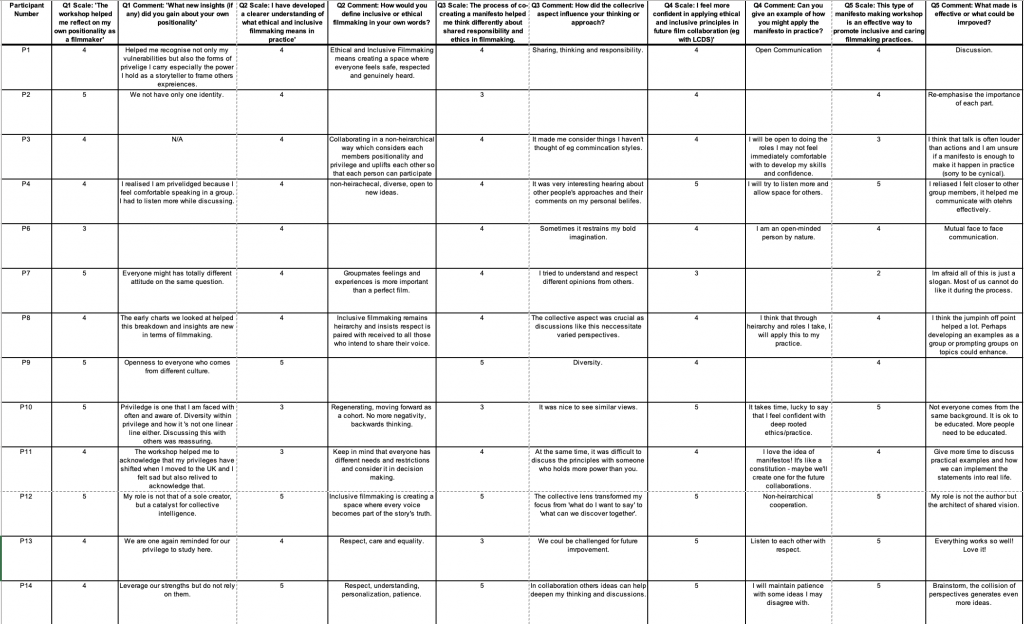
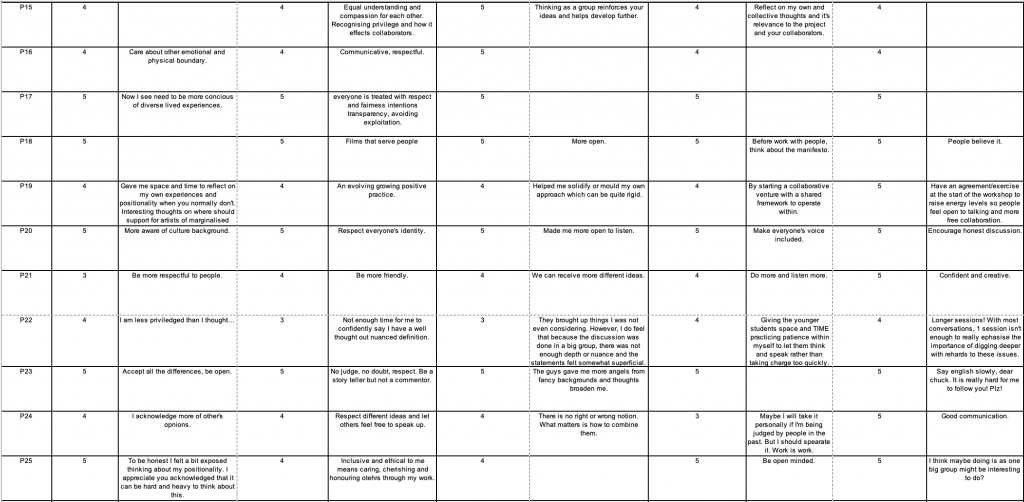
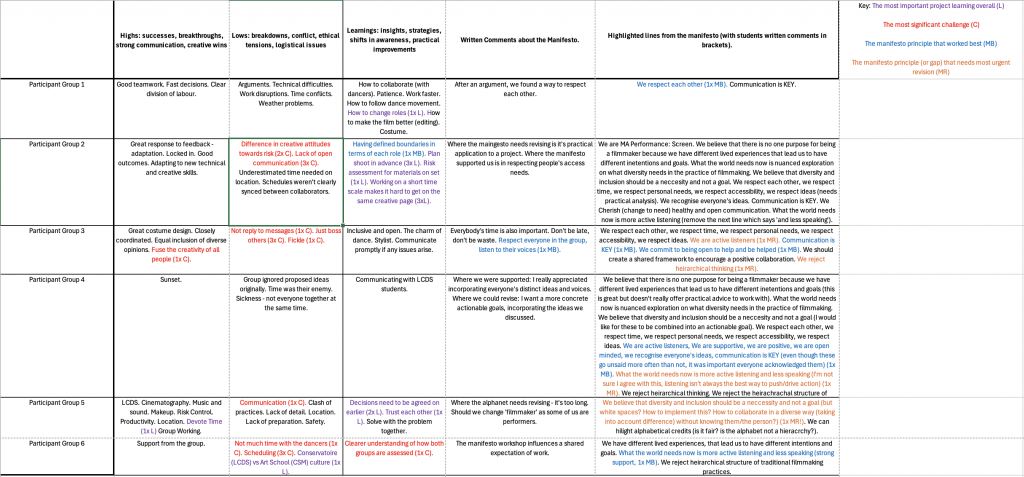
Below are screenshots of the initial anonymised data sets, with Likert percentages calculated. This was my first time working with a Likert scale and I looked into different ways of creating calculations and understanding the data. I write more about this in the next blog post.

Bibliography
YouTube videos
Okolie (2023) Likert Scale Data Analysis and Interpretation of Results [Video]. YouTube, 14 July. Available at: https://www.youtube.com/watch?v=uHteOFO84MM (Accessed: 10 December 2025).
Edstar Analytics (2022) Analyzing Likert Scale Data Using Excel: Computing Totals and Percentages (Intermediate) [Video]. YouTube. Available at: https://www.youtube.com/watch?v=bkYWyahlThQ&t=314s (Accessed: 10 December 2025).
Research article
Joshi, A., Kale, S., Chandel, S. and Pal, D. K. (2015) ‘Likert scale: explored and explained’, British Journal of Applied Science & Technology, 7(4), pp. 396–403. DOI: 10.9734/BJAST/2015/14975.
Leave a Reply