
I decided on a research method that uses arts based qualitative and quantitative approaches. I adopted a mixed-methods, participatory approach in order to capture both measurable shifts in student understanding and the lived, relational experiences of collaborative practice. I chose methods that invited reflexivity, ethical engagement, and shared knowledge production, aligning with the values underpinning the manifesto intervention itself. These are the different research approaches I selected, with reflective rationale’s for why I chose them, as well as challenges that they posed:
•Interview with course leader
Rationale: An interview with Gabi Tropia, the course leader, was used to situate the project within its institutional and curricular context. This enabled insight into existing pedagogical aims, expectations around collaboration, and previous challenges that needed to be addressed. Speaking with Gabi at different stages was very helpful to ensure that I was also being reflective about my own positionality within the institutional power structures, and also to give context to the LCDS collaboration as this was not a project I had personally set up or would be leading on. Choosing to work on this project was also conscious as it meant I was less directly involved in the teaching itself, so as not to skew the research be being too involved in the collaboration itself.
Challenge: One challenge I encountered was negotiating my dual role as both colleague and researcher. As Gabi holds institutional authority as my line manager, I was aware that the conversation was shaped by existing professional relationships and power dynamics, including fitting my research into my job role, and designing something that aligned with the course’s agenda. Although I do feel the course agenda and my personal research agenda were aligned, it still was an interesting challenge to balance this.
•Pre-action anonymised data evaluation of cohort
Rationale: The evaluation of anonymised cohort data prior to the intervention provided a baseline understanding of students’ identities such as race, nationality, gender and age, which helped to ensure that the intervention responded to the actual cohort rather than my assumptions.
Challenge: Of course this data on it’s own has many limitations and certainly does not paint a full picture of the participants, which is why it was only used in the initial planning stages. I found that the direct data provided by the students about their lived experiences in the workshops and questionnaires was much richer and provided more nuanced account of the students identities and experiences.
•Questionnaires
Rationale: Questionnaires were used to collect both quantitative Likert-scale data and qualitative written reflections, allowing for a broad view of participant responses. This method enabled me to identify patterns across the cohort while also capturing individual perspectives. Questionnaires were particularly appropriate for supporting reflective distance, giving students time and space to articulate their thinking privately and honestly. All of the forms were completely anonymous.
Challenge: Although questionnaires allowed for broad participation and a mix of quantitative and qualitative data, they limited opportunities for clarification or deeper exploration. Some responses were brief or ambiguous, making interpretation challenging. I was also conscious that power dynamics within an educational setting may have influenced how honestly students responded, despite assurances of anonymity. Some student’s also have ISA’s and some require additional language support, which means that reading and writing is not always the best format for students to express themselves freely. This required me to treat the data as indicative rather than definitive.
•Participatory workshops
Rationale: Participatory workshops were central to the research design, reflecting the project’s commitment to co-creation, dialogue, and collective reflection. The two workshops functioned both as pedagogical interventions and research methods, merging the boundary between learning and data generation. They allowed students to actively engage with ethical questions through discussion, creative exercises, and manifesto making and revision, aligning with the pedagogy of Paulo Freire and writing of Pablo Helguera which centres care-led pedagogical principles.
Challenge: Facilitating participatory workshops while simultaneously researching them presented challenges. I had to balance creating a supportive, open learning environment with the need to collect meaningful data. At times, this raised ethical questions about where facilitation ended and research began. Additionally, not all participants engaged equally, which highlighted ongoing challenges around confidence, accessibility, and group dynamics in participatory settings.
•Focus Groups
Rationale: Focus groups enabled deeper exploration of shared experiences and tensions emerging from the collaborative projects. Working in mixed groups allowed participants to reflect across different collaborations, generating comparative insights, as well as reflecting the theories of Michael Renov around the importance of discovering more about oneself by being witmess to others experiences. This method supported dialogic knowledge production and surfaced relational dynamics that might not have emerged through individual methods alone.
Challenge: In focus groups, dominant voices sometimes shaped the direction of discussion, potentially marginalising quieter participants. Despite structuring activities to encourage shared contribution, I remained aware that group dynamics and peer relationships influenced what was said and what remained unspoken. As a facilitator, I had to actively reflect on my role in guiding conversation without directing it toward preconceived outcomes.
•Collective group selections of data.
Rationale: Inviting the students to collectively identify and select significant data points positioned them as co-analysts rather than research subjects. This method supported transparency, ethical participation, and reflexivity, while also reducing the risk of my sole interpretive authority. It aligned with participatory action research principles by acknowledging that participants are best placed to recognise what matters in their own experience. This meant that the revised manifesto and suggestions for how the research should continue to develop are very much shaped by the students.
Challenge: Inviting participants to collectively select and interpret data challenged traditional notions of researcher authority, but it also introduced uncertainty around consistency and rigour. Different groups prioritised different insights, which complicated synthesis across the data set. I also had to relinquish a degree of control over meaning-making, which required trust in the process and ongoing reflexivity about my role as both curator and analyst.
•Methodological Reflection
Together, these methods created an iterative research design that combined individual reflection, collective dialogue, and institutional perspective. This approach supported both the evaluation of the intervention’s impact and the development of ethical, inclusive pedagogical practice. Importantly, the methods mirrored the values of the manifesto itself, reinforcing consistency between research process and research purpose.
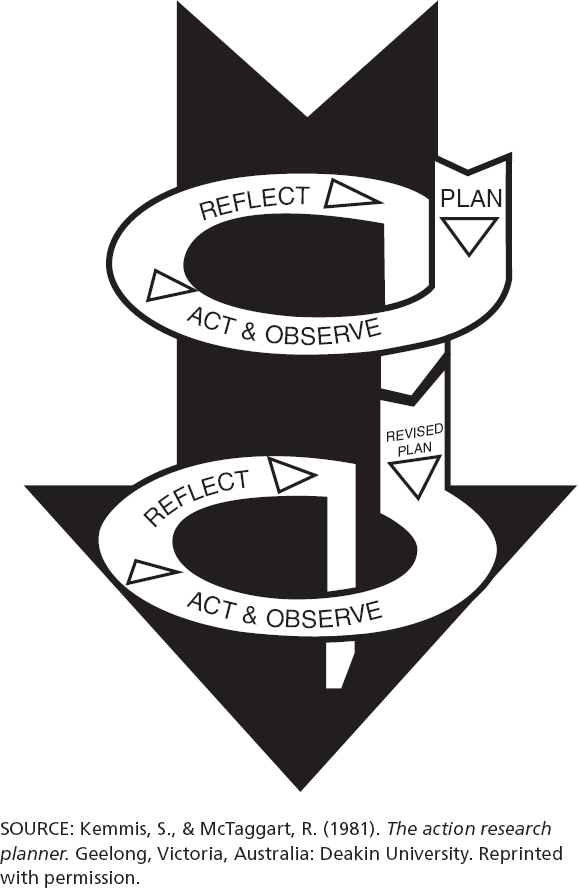
I found that the Kemmis and McTaggart action research spiral was a useful diagram to illustrate how these different research tools formed an iterative process. I feel that in this Unit I have only been able to complete one ‘loop’ of the spiral but have a strong sense of how I will revise the plan to move the project forward (I have written more on this in my final blog post).
Below is the initial manifesto workshop slides that I shared with the students participating in the research project:
The aims of the workshop were to:
- Reflect on positionality and ethical responsibilities in collaborative filmmaking.
- Explore the use of manifestos as both creative declaration and ethical contract.
- Use manifesto making as a creative process to articulate collective commitments to inclusion, care and accountability.
- Produce a shared manifesto that can guide future collaborations with external partners (eg LCDS).
I started the workshop with a reminder that this was a space of respect, curiosity, listening to understand, assuming positive intent and being kind with one another.
I tried to make the workshop as inclusive and interactive as possible, utilising space and pedagogical design to heighten engagement. This included elements such as:
- Circle to start
- Mixture of individual, pair, small group and full group work
- Using tactile materials
- Presentation on screen with live captioning
- Print out sheets
Below is a link to the slides for the second workshop, that took place 3 weeks later after the collaborative project with LCDS ended.
The aims of the workshop were to:
– Reflect holistically on the full collaboration experience.
– Support students in articulating the learnings, the challenges and the successes of the collaboration.
– Evaluate whether the manifesto influenced their work and how it could be improved.
– Collect qualitative and quantitative data for the research.
I will share the questionnaires and student facing documents including questionnaires on the next blog post.
Bibliography
Cook, T. (2009) ‘The purpose of mess in action research: building rigour through a messy turn’, Educational Action Research, 17(2), pp. 277-291.
Freire, P. (1992). Pedagogy of hope: Reliving pedagogy of the oppressed.
Helguera, P. (2011). Education for socially engaged art.
Kemmis, S., & McTaggart, R. (2007). The action research planner.
Leave a Reply